How to Check Your Water Meter for a Possible Leak
A controlled no-use test can show whether water continues to move through the property’s metered system. It can support a leak investigation, but it cannot locate the source.
Run a controlled meter check
- Locate the meter
In San Diego, the meter is commonly near the curb in a concrete box marked “water.”
- Record the display
Photograph or write down all digits and note any low-flow or leak indicator.
- Wait with no water use
Keep every expected water use off. A longer interval helps reveal smaller continuous flow.
- Compare readings
Any change means metered water was used during the test; investigate expected devices before assuming a hidden pipe leak.
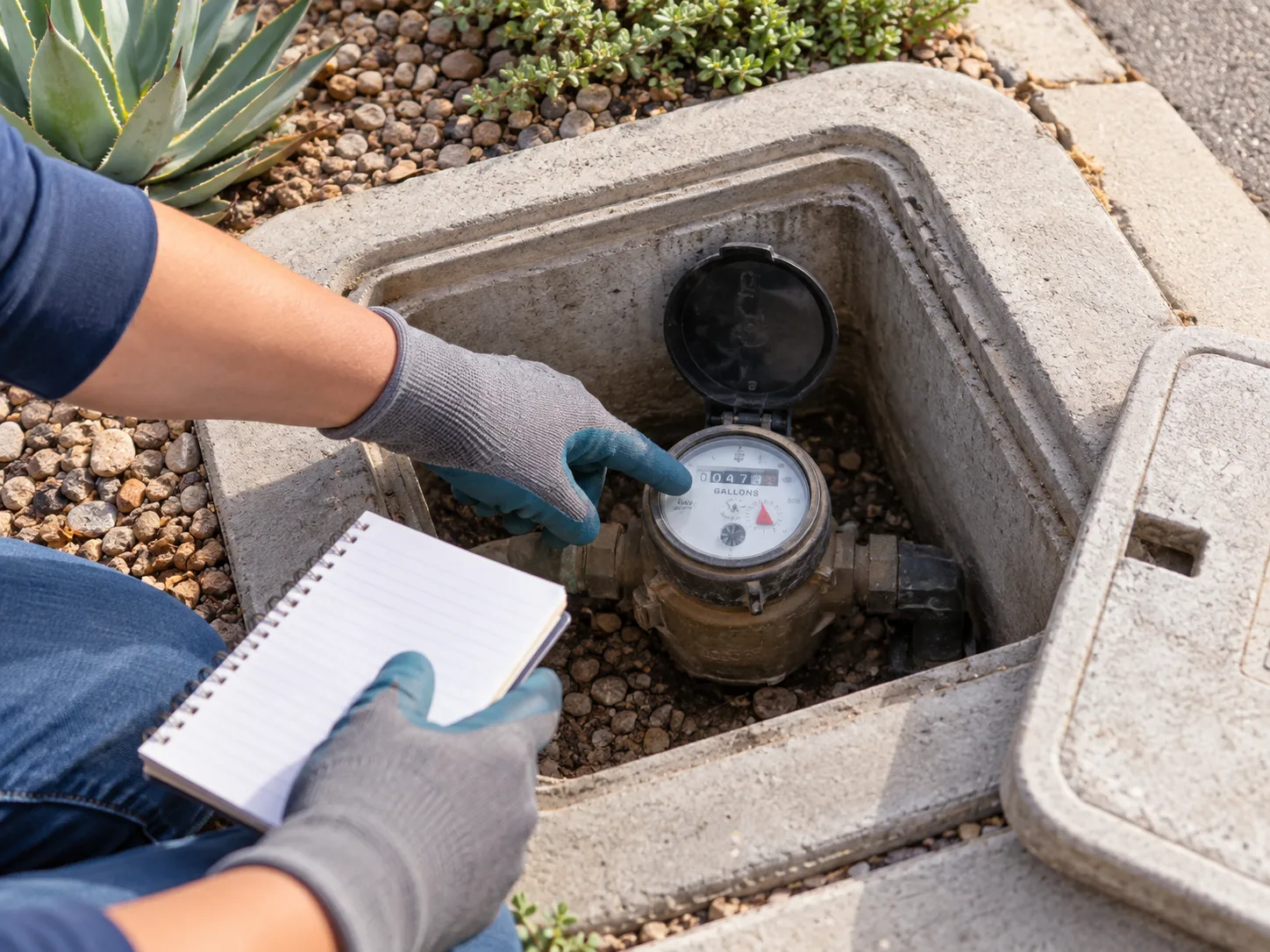
Make the no-use period truly quiet
- Turn off faucets, showers, dishwashers, washing machines, and other manual water use.
- Pause irrigation and account for toilets, ice makers, softeners, filters, and automatic fill devices.
- Tell everyone in the home not to use water during the test.
- Use caution around the meter box. Do not put fingers under a heavy lid or touch utility valves unnecessarily.
What meter behavior can—and cannot—tell you
No change: no continuous metered flow was recorded during that interval. An intermittent leak can still be missed.
A small change: check toilets, automatic devices, and longer-term flow before assuming a concealed line.
Strong continuous movement: water is flowing. If all expected use is truly off, isolate safely and call.
San Diego meter units
The City of San Diego states that its meters measure cubic feet. One cubic foot is about 7.5 gallons, and bills use hundred cubic feet (HCF).
Approximate conversion: cubic feet × 7.5 = gallons.
Choose the next check based on the pattern
| Meter result | First thing to verify | Reasonable next step |
|---|---|---|
| No change | Was the symptom intermittent? | Repeat when the symptom normally occurs or document moisture changes. |
| Slow movement | Toilets and automatic devices | Isolate obvious uses, then repeat the test. |
| Stops at the property shutoff | Accessible shutoff was operated safely | Flow is likely downstream on the property side; professional isolation can narrow it. |
| Strong continuous flow | All expected uses are definitely off | Control water if safe and call for urgent assessment. |
Do not treat the meter test as a repair procedure. Avoid utility-side valves, unsafe boxes, and wet electrical areas. If the situation is hazardous or water is rapidly spreading, prioritize safety and urgent help.
Authoritative references
City of San Diego: Your Meter, Water Pressure & Plumbing System · U.S. EPA WaterSense: Home Maintenance
Last reviewed September 24, 2026.
Digital and analog displays show flow differently
Use the meter’s actual display and utility guidance rather than expecting every model to have the same leak indicator.
| Meter style | What to record | Common interpretation mistake |
|---|---|---|
| Digital display | All displayed digits, flow indicator, and any screen cycle before and after the no-use period | Assuming a blank or sleeping display means no flow without activating the display as instructed |
| Analog dial | Register digits, sweep hand position, and low-flow indicator if present | Watching only the large register when a smaller indicator shows low flow |
| Either style | Timestamped photos and the exact test interval | Calling one change a hidden pipe leak before toilets and automatic devices are excluded |
Water meter test questions
Does a moving meter prove the leak is under the slab?
No. Movement shows that water is flowing somewhere on the metered property side. The cause could be a fixture, irrigation, appliance, hidden line, or other expected or unexpected use.
How long should I observe the meter?
A short observation can reveal stronger flow. A longer controlled period can make very low flow easier to identify. The U.S. EPA suggests comparing readings before and after a two-hour period with no water use.
Why might the meter move even when no faucet is open?
Toilets, irrigation controllers, water treatment equipment, ice makers, automatic pool fill devices, and other appliances can use water without an open faucet. Account for those devices first.
Should I open the meter box myself?
Only if it is safe and permitted. The City advises using a tool—not fingers—to lift a meter-box lid and checking for insects or animals. Do not operate or damage utility equipment.
The meter changed and normal water use was off?
Call to explain how quickly the reading changed, which devices were ruled out, and whether you see moisture indoors or outside.